


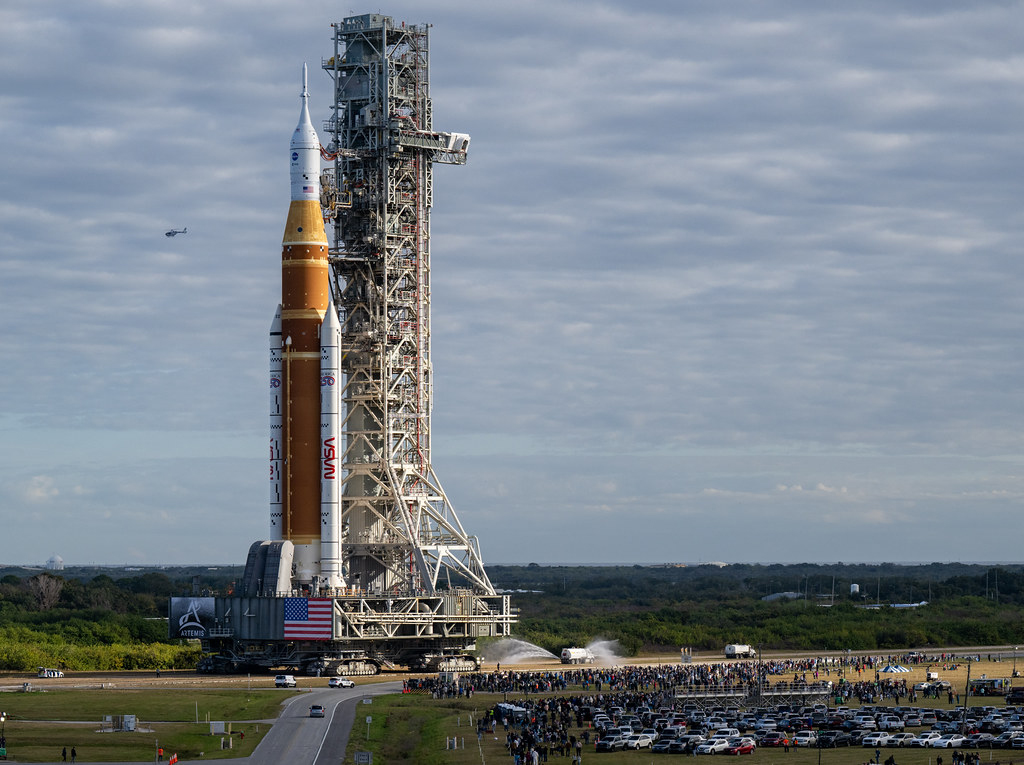






































After 54 years, NASA returned humans to deep space with the launch of Artemis II on April 1, drawing an estimated 400,000 spectators to Cocoa Beach Pier and 18 million online viewers. As the countdown approached 6:35 p.m. EDT, anticipation built along Florida’s coastline before the rocket lifted off on its 10-day mission around the moon.
The spacecraft carried American astronauts Christina Koch, Victor Glover and Reid Wiseman and Canadian Space Agency astronaut Jeremy Hansen. Koch is the first woman and Glover the first person of color to travel this far into space, while Hansen is the first Canadian assigned to a crewed lunar mission, The New York Times reported.
“I can’t recall a period in my life when I didn’t want to be an astronaut,” Glover told The New York Times.
Spectators near the launch site reported earthquake-like tremors from the rocket’s twin solid boosters and four RS-25 engines, which propelled the 5.75 million-pound vehicle off the ground.
Artemis II reached a maximum distance of 252,799 miles from Earth — about 4,100 miles farther than Apollo 13 — setting a record for a crewed mission to the moon. After entering high Earth orbit for system checks, the Orion spacecraft traveled behind the moon on April 6, temporarily losing communication with NASA for about 40 minutes, before splashing down in the Pacific Ocean near San Diego on April 10.
Despite the smooth mission, risks remained. Space debris continues to pose a major hazard. Even a fragment as small as one centimeter could damage the spacecraft at speeds up to 22,000 mph, The New York Times reported. The crew also passed through the Van Allen radiation belts, where elevated radiation levels threaten both astronauts and onboard systems.
NASA designed the Orion spacecraft and Space Launch System over several years to withstand these conditions, including extreme heat during reentry and prolonged radiation exposure. Orion, built by Lockheed Martin, flew atop the Space Launch System, a rocket developed with contributions from Boeing and Lockheed Martin.
The mission followed a “free-return trajectory,” allowing the spacecraft to loop around the moon and return to Earth using lunar gravity with minimal engine use. In the event of an emergency, astronauts could have performed a “direct abort,” firing Orion’s main engine to return home more quickly, NASA official Amit Kshatriya told CNN.
Artemis II did not attempt a lunar landing, as NASA’s human landing system is still in development. Instead, the mission serves as a precursor to future landings, which NASA currently aims to begin as early as 2028.
“I think it’s really cool,” senior Chloe Son said. “The story about the astronaut naming the crater for his wife was really sweet.”
“I thought it was really great that the most qualified astronaut on the mission was the female astronaut,” senior Sophie Pitt said. “That was a really proud moment.”
“Extraordinary, generational, and scientific,” senior Linus Rhee said in response to his thoughts on the moon mission.
After the planned lunar landing of Artemis IV in 2028, NASA plans yearly lunar landings to further develop a permanent base on the moon, with goals to expand toward human missions to Mars and eventually deep space.
More than half a century after the Apollo era, Artemis II signals a renewed push toward sustained human exploration of deep space.