
















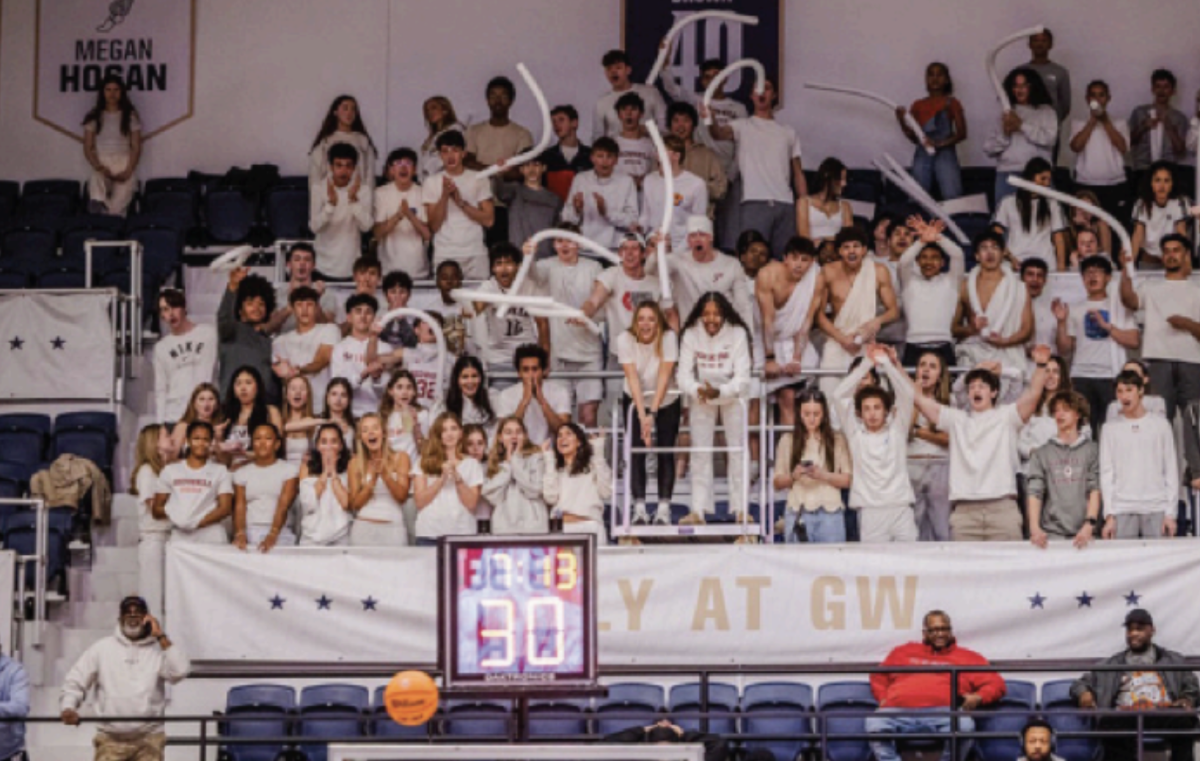
During the ISL and MAC basketball tournament games, something shifted in and beyond the Pearson Athletic Center. The student section was more abundant, rowdy and aesthetically coordinated, according to the Friends Athletic Network (FAN) Heads. For the players on the court, that difference from previous years was tangible.
“I definitely play with more energy,” girls basketball captain and senior Delaney Hughes said. “In our ISL final game versus Bullis, the fan section was amazing. Previously, we lost to Bullis twice, so seeing the fan section at our final game gave us even more motivation to compete and eventually win.”
Hughes noted that while she feels the same baseline nerves before any game, the presence of a large crowd changes the tone of preparation.
“If there is a big crowd, our pre-game talk is definitely more hype,” she said. “To see my friends and classmates cheering me on means everything to me.”
In the team’s final game against St. John’s, Hughes described a particularly moving moment.
“When I got subbed out for the final time, I looked up and saw so many people supporting us,” she said. “It made me tear up. Even though we lost our last game, seeing everyone together and cheering us on made me so happy.”
Sophomore Jordan Johnson echoed that sentiment, explaining that large crowds directly affect performance.
“Home crowd support adds that extra push to show up and show out,” she said. “To see that level of support personally shows me that people care, and makes the work my teammates and I put in ten times more worth it and meaningful.”
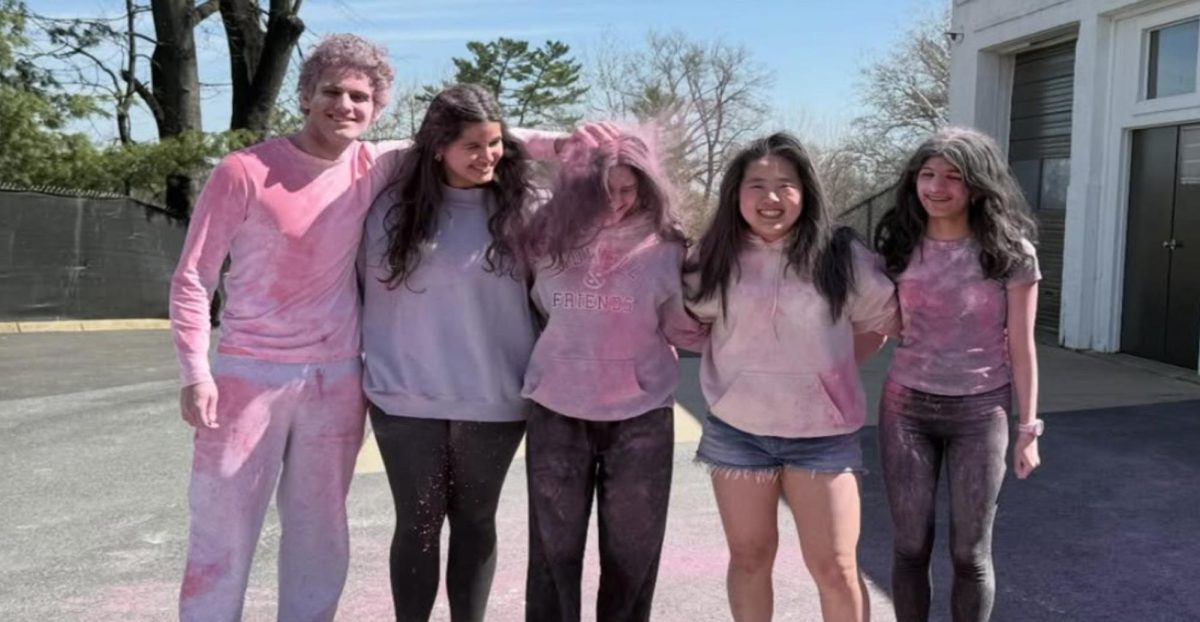
Students also noticed the shift in atmosphere. Sophomore Nathaniel Bohlen described the games as moments of collective energy.
“There’s a lot of unity and school spirit at the games,” he said. “Students come together to support our programs.”
That sense of unity did not occur incidentally. According to senior and FAN Head Lexi Orr, increasing attendance begins with intentional communication.
“Our main ways to increase attendance are to communicate broadly about the games,” Orr said. “For regular games, we will post on our story. For larger games, we will post on the account, and for the most important ones we will send an email as well.”
Theme selection is also deliberate.
“We usually have a quick conversation to choose a theme,” Orr explained. “Depending on the importance of a game, we will choose a theme accordingly.”
For example, the group selected more elaborate themes, such as “USA” for state tournament games, while simpler themes, like “blackout,” were used during the regular season.
“I think themes mainly make the games more fun. People get excited to dress up for a certain occasion,” Orr said. “They increase the cohesion of our fan section and make us look more like a unit together.”
Senior and FAN Head Sisi Kostorowski emphasized that chants are equally important, especially when momentum shifts during a game.
“I think the most important thing for our student section when momentum is high or low is our chants,” Kostorowski said.
“It keeps every fan involved, sometimes gets in the other team’s head, lets our players know we are always cheering them on, and creates an almost tangible energy in the gym.”
Kostorowski also pointed to the teams’ success as a major factor behind the increase in attendance and energy over the season. Both the boys’ and girls’ teams played nationally ranked opponents, secured MAC and ISL championships and made deep postseason runs.
“It’s hard not to get excited for games when your teams are consistently playing so well,” she said. Still, she believes the turnout reflected something broader about the school community.
“Especially in the last few weeks of the season, when the games got more important, it showed how the school shows up for each other in times of need,” Kostorowski said. “There were students from every grade, some who had never come to games before, showing up in theme and cheering on their peers when it mattered most.”
Upper School Human Behavior Teacher Joshua Moyer offered a psychological explanation for why that energy matters.
“There’s a concept in psychology called social facilitation,” Moyer said. “It basically says that individuals perform better when an audience is watching than when they perform alone.”
According to Moyer, the presence of a crowd increases arousal, a heightened physiological state that can sharpen focus and boost adrenaline. In most cases, especially for well-practiced tasks such as competitive athletics, this heightened state enhances performance.
“You’ll see this with stand-up comedians,” he explained. “They play much better to a full audience. If one person is laughing, it causes another person to laugh, and it builds.”
Similarly, “if a player senses that the audience is on their side, it motivates them to feel more confident in all their practice and talent,” Moyer said.
Moyer also connected crowd participation to a deeper human need for belonging. Referring to psychologist Abraham Maslow’s theory of human motivation, Moyer explained that, beyond basic physical needs, people have an instinctual need for love and belonging.
“When we find things that bind us together, it makes us feel like we’re part of something,” Moyer said. “We’re social creatures.”
Coordinated themes and chants amplify that sense of connection. When students dress alike and act in unison, participation becomes natural. In large groups, individuals may experience “deindividuation,” a state in which personal identity fades and group identity becomes more prominent.
“In a positive way, that can cause more unity and cheering,” Moyer said. “But it can also create pressure.”
That pressure, he noted, can occasionally hurt performance if athletes feel they are not meeting expectations or are more reserved. Still, psychological research suggests that, more often than not, supportive crowds enhance confidence and effort on the court.
The importance of crowds has become especially significant after the COVID-19 pandemic, where several sports organizations, such as the NBA, used virtual crowds to motivate players.
Sports, Moyer added, remain one of the few modern communal “third spaces.” Rivalries and team loyalty create a built-in sense of unity, satisfying the desire to belong, which is especially prevalent among high school students.
The goal is for players to feel “like they have an army behind them,” Kostorowski explained. This season, the size and coordination of the crowds suggest that they did. Ultimately, the experience appeared to matter just as much to those in the stands as it did to those on the court.