






















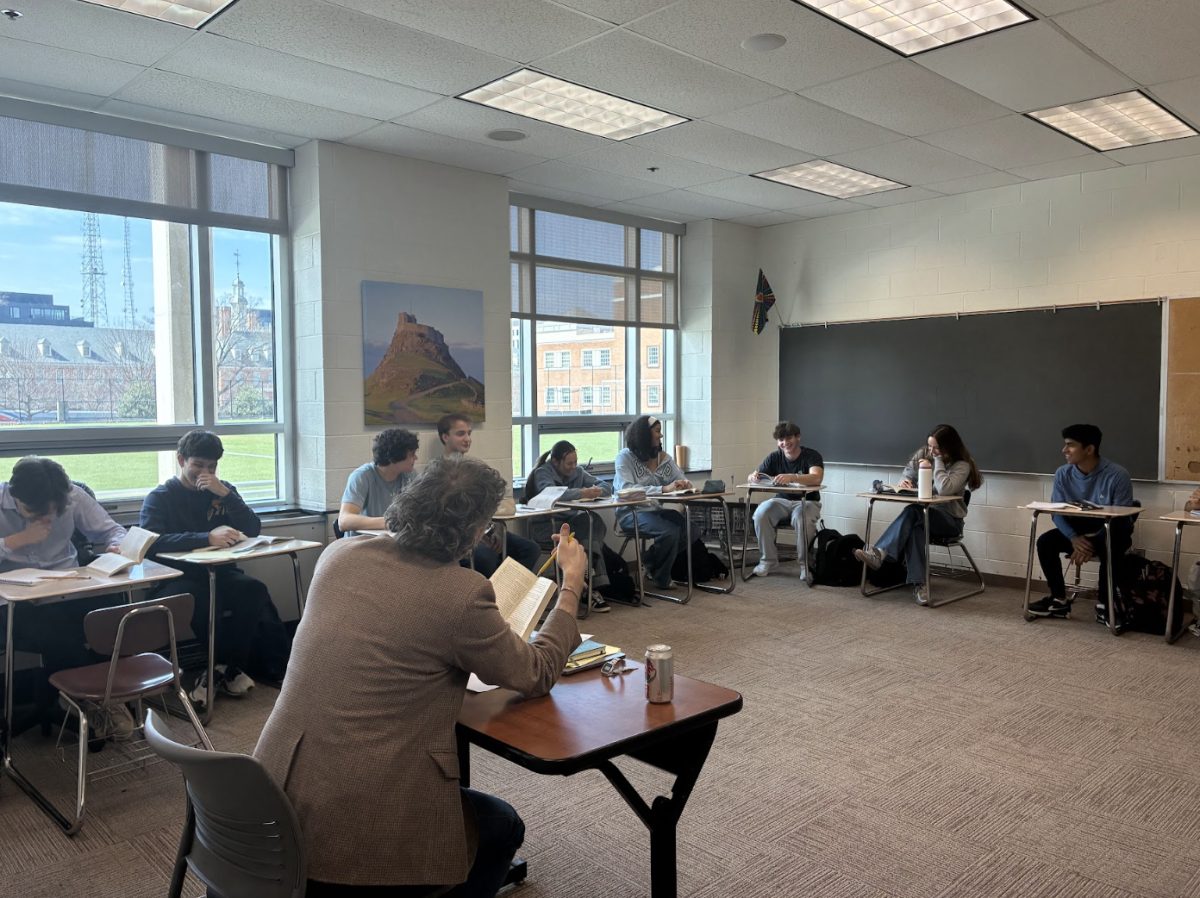
Throughout a student’s four years at Sidwell, senior year is where they earn the most freedom in course selection. However, this freedom is fairly limited in one subject: English. Despite the plethora of English semester-long course offerings, rising seniors have little say in which English courses they will take next year. The current system requires students to specify one English course they do not want to take each semester, leaving the remaining courses — eight for the winter, seven for the spring — to be randomly assigned to them.
Additionally, a new semester-long senior elective, Introduction to the Craft and Practice of Writing Fiction, will only be open to students beginning in the 2026–2027 school year who drop a core academic subject. These two elements illustrate the lack of flexibility available to rising seniors in their English course selection. Rising seniors should have the opportunity to rank their English course preferences, and the creative writing elective should be open to seniors as a sixth course — counted as an arts class — without requiring dropping an academic subject.
There are logistical reasons behind the current system. As Nikolin Eyrich, the Assistant Principal for Academic Affairs, explained, “English is the only subject with a four-year requirement; English courses are never electives.” Because every senior must be enrolled, the scheduling office depends on English’s flexibility. “In the senior year, we run more of what we call ‘singletons.’ Singletons are classes we run once a day, so when students ask for multiples of these kinds of courses, those requests shape a schedule. We need the flexibility of English semester courses, which we run throughout the day, to give students the courses they want,” Eyrich also added.
She also noted that the current system of eliminating one course per semester is not without thought: “Though we do not allow students to rank the English courses they’d like, we do allow students to eliminate one course per semester. Even that ability, which might feel minor on an individual level, puts very real constraints on when we can give you English, so within the realities of the complicated scheduling process we have, we try to give students some ability to provide input.” Zachary Harvat, head of the English department, made a similar point: because other subjects already offer so much choice, adding another ranked preference into the mix would make students less likely to get their top picks in those other areas. He also noted that even if ranking were implemented, students would likely end up with their fifth or sixth choice, making it a hollow preference.
These are fair points. However, they do not change the fundamental problem. Firstly, English courses should be ranked to match the level of freedom seniors have in selecting their other courses. Out of seven science offerings, rising seniors have complete autonomy in their course selection. The same is true for language, arts and computer science. Perhaps the best example is history. History courses for rising seniors follow the same structure as English courses: they are semester-long and focus on a specific subject. Rising seniors can rank their history courses by preference for each semester.
For example, a student interested in politics may rank United States Foreign Policy as their first choice, American Government as their second, Political and Philosophical Thought I as their third and so on. In the college application process, the courses that seniors choose to take are important, as they reflect students’ academic interests more specifically than in previous years. For a student considering a political science major, taking those courses rather than, say, Art History, would reflect their academic interests better to colleges. Vice versa, an artistically inclined student would thrive better in Art History, and that impression would be stronger for colleges.
Ms. Eyrich also noted that “all senior English courses work on the same skills. They vary by topic, genre, and period, but we hope that students might discover a newfound interest.” Certainly, unexpected classes can become favorites. However, this is not a universal case. Despite being a fellow humanities subject, English course selection is completely random. A student with a strong disinclination towards drama could end up in Page and Stage. A student deeply interested in African American history may never get to take African American Literature. This randomness in selection manifests in students’ transcripts, where they may never be able to convey their academic interests to colleges through their English subjects. For students interested in the humanities, this is detrimental to their interests and application overall.
If Harvat is correct in that students would end up with their fifth or sixth choice, that is still better than having no input at all beyond eliminating a single course. A fifth choice is still a choice. English course selection should follow the same process as history course selection. Students would enjoy their courses more, thrive in an environment better suited to their academic interests and possess a more holistic representation of those interests to colleges.
Additionally, a new semester-long senior elective has been added, beginning with the class of 2027. Introduction to the Craft and Practice of Writing Fiction will allow students to develop their creative writing skills, a skill not often practiced in normal English classes. However, this course is only open to students who drop another core academic subject. The current Sidwell requirement is that if a student takes the maximum of six classes, the sixth must be an arts or computer science class.
However, this senior elective should not be bound by this rule. A fiction writing class is extremely different from a traditional reading and discussion-based English course. In a way, writing fiction can be considered a form of art. This course should be treated similarly to computer science and arts courses. Many current juniors have expressed interest in this course but have been deterred by the requirement to drop an academic subject. It is unlikely that this semester-long course will even achieve the level of interest it aspires to due to this harsh rule.
Ultimately, English course selection for rising seniors is inflexible and hinders students’ growth and enjoyment in their senior-year English courses. The scheduling constraints are real, and the work Ms. Eyrich and the scheduling office do is not easy. But the solution should not be to strip students of input entirely. The same flexibility offered in other subjects should be extended to English, especially given that it is a subject of creativity and imagination.