







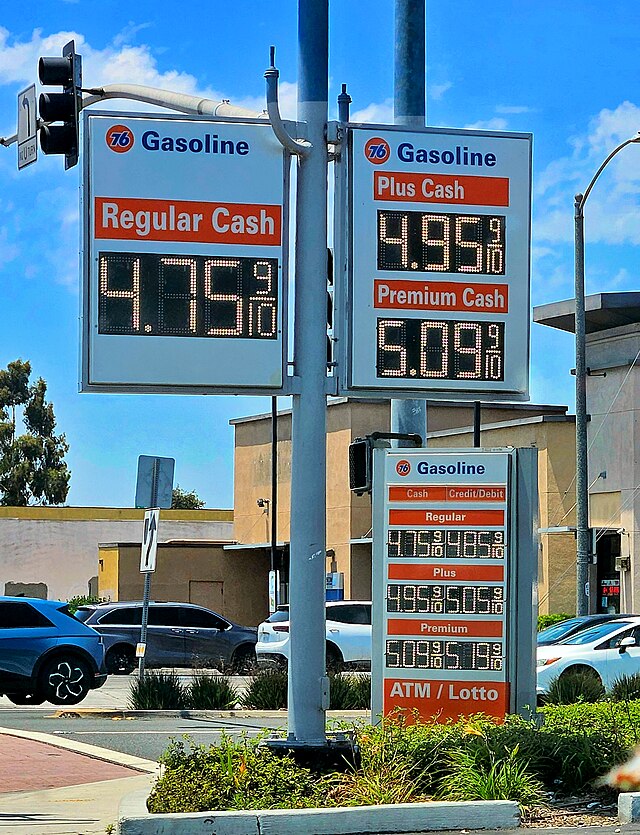




























The national average price for gasoline has climbed to around $4.02 per gallon as of March 31, putting pressure on drivers and raising concerns about transportation costs nationwide. With nearly uninterrupted increases since the war in Iran began in February, the $4 price marks the highest gas price in nearly four years.
Other fuel prices are also rising, with diesel prices at an average of $5.42 per gallon as of March 30. NBC reports that the average U.S. household will spend an additional $740 this year due to rising gasoline prices. A poll from Reuters adds that 55% of Americans report financial impact from rising gas prices, while 21% say gas prices affected their finances “a great deal.”
The sudden increase in gasoline prices is largely due to the war in Iran. After the closure of the Strait of Hormuz, energy transport across the Middle East has slowed or stopped entirely. The waterway is responsible for one-fifth of the world’s oil supply and has forced the shutdown of at least 12 million barrels per day. Due to the closure, crude oil prices, a vital ingredient in gasoline and diesel, have surged.
Before the conflict began on Feb. 28, gas prices averaged $2.98 per gallon, while diesel was about $3.76, with around 100 ships making it through the passage per day. As of April 18, there was still much confusion over the status of the Strait of Hormuz, limiting the flow of oil to the rest of the world.
U.S. President Donald Trump describes the price increases as a temporary disruption with little impact. More recently, Trump threatened to bomb Iran on April 7, stating, “A whole civilization will die tonight, never to be brought back again,” if Iran does not open the Strait of Hormuz.
However, the next day, Iran accused the United States of violating the ceasefire, and traffic at the Strait of Hormuz remained at a standstill. Yahoo Finance reports that Brent crude, the primary global benchmark for pricing crude oil, soared to a record of $144.42 a barrel on April 7, signaling that the Iran ceasefire agreement is unlikely to resolve rising prices.
Matthew Martin, a senior U.S. economist at Oxford Economics, wrote that if oil prices remained at $140 a barrel for an extended period, it could trigger an economic downturn. Similarly, analysts warn that high gas prices could cause households to spend less, increasing the risk of economic damage unless the conflict is soon contained. Martin agrees that the duration of the war is the critical factor in assessing the damage from rising oil prices.
While oil prices had dropped to around $84 per barrel as of April 17, the future of the market remains uncertain. CNBC noted that the damage from the sudden spike in oil prices will already take months to recover from. Amena Bakr, an expert on the Middle East and OPEC, explains that it could take as long as five months to restore capacity.
The CEO of Kuwait Petroleum Corporation said it would take four months for the Gulf Arab producers to fully restore their production to pre-war levels. For now, CNBC concludes that the main question for the future of oil pricing is how long the war in Iran will last and whether the ceasefire will stick.
Nonetheless, average prices remain below the record highs of $5.01 for gas and $5.81 for diesel set in 2022, following Russia’s invasion of Ukraine. However, the BBC explains that prices this time could still have a greater impact on households.
Christopher Hodge, chief economist for the U.S. at Natixis CIB, states that consumers are faring much worse now than in 2022, as job and wage growth was stronger then, and during the pandemic families built up savings.
The conflict in the Middle East has also greatly affected other countries. NBC News claims that oil-dependent nations in Europe and Asia have been facing much more severe energy shocks compared to the United States.
In the U.K., average gas prices have risen by 14% and diesel by 27% since the war began. Other countries, like Bangladesh, Slovenia and Sri Lanka, have introduced fuel rationing. Two Australian states have offered free public transport to discourage driving, and the Australian federal government announced it would halve the nation’s fuel tax.
The increase in prices is not evenly distributed across the United States either. Gasoline prices vary by state, with California having the highest average at $5.89 and Oklahoma the lowest at $3.27. This means the national average only tells part of the story, since local drivers may be paying well above or below $4.
President Trump campaigned on lower gas prices and a booming economy during the 2024 presidential campaign. He also spent much of last year asserting he had accomplished this, declaring that last month was a “golden age” for America.
Reuters explains that the sudden rise in oil prices due to a war Trump engaged in has lowered his approval rating on the cost of living. Longtime industry analyst Andy Lipow corroborates the view that Americans are experiencing “sticker shock” from rising gasoline prices and higher airline ticket prices due to rising jet fuel costs.