



















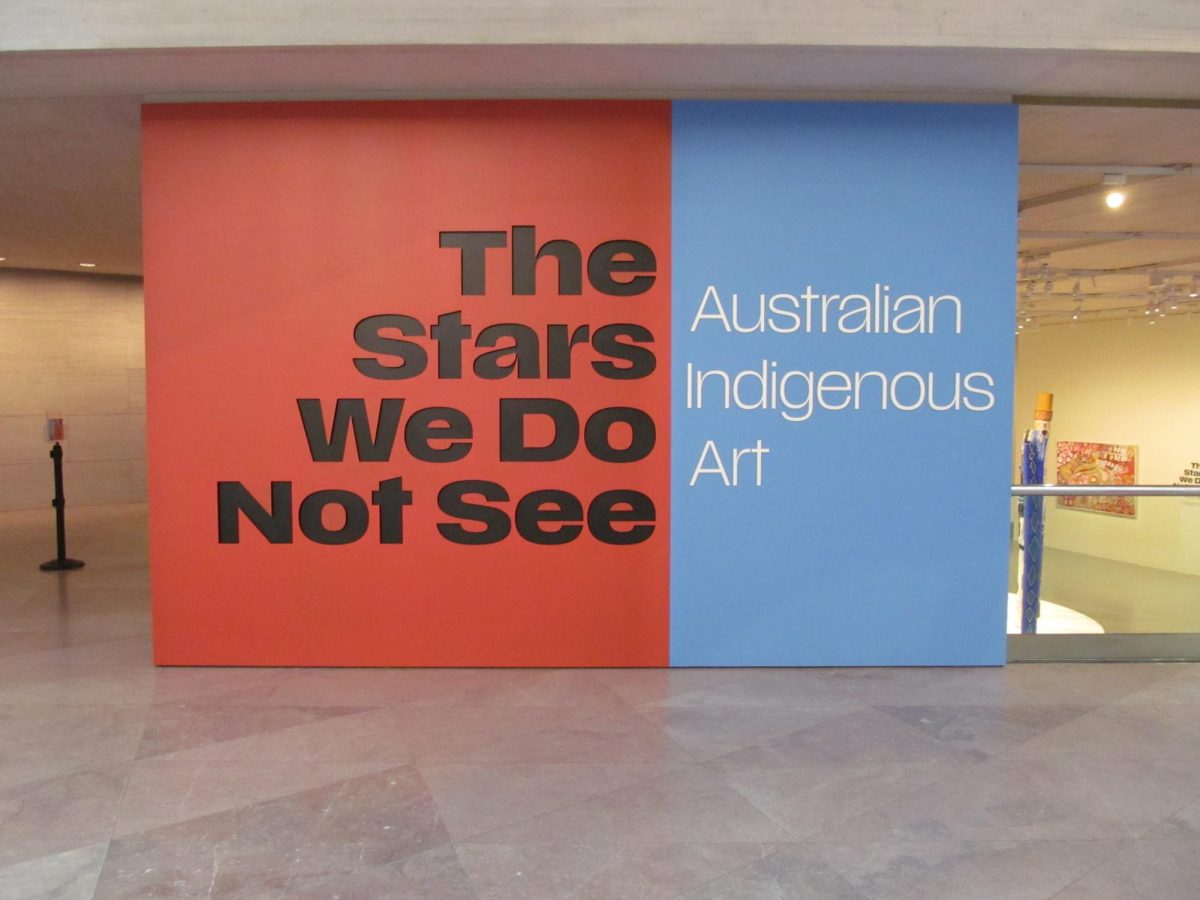
Land, language, culture and country — these themes animate “The Stars We Do Not See,” an Australian Indigenous art exhibit at the National Gallery of Art. Drawn from the National Gallery of Victoria’s collection, the exhibit’s pieces both pay homage to Australian Indigenous tradition and reenvision it for a changing world.
“The Stars We Do Not See” begins with a greeting. In a looping video, Wurundjeri elder Aunty Joy Wandin Murphy offers visitors a Welcome to Country by presenting gum leaves, a “cultural protocol in Australian Indigenous communities.”
“Country is not just landscape,” says Wandin Murphy. “It is our people and the animals, the past and the present and the future.”
Artists explore each of those facets of Australia, in turn, throughout the exhibition.
History and tradition are central to the exhibit. The oldest artwork shown is a 19th-century notebook filled with drawings of Indigenous cultural practices by Tommy McRae, an artist commissioned by settler Roderick Kilborn. McRae’s art, which includes lovely nature scenes, “preserve[s] a vital record… during a period of significant upheaval,” according to the National Gallery. In addition, works like Jimmy Jampijinpa Robertson’s “Ngurlu Jukurrpa (Seed Dreaming)” and Tim and Clifford Tjapaltjarri’s exquisite, monumental “Spirit Dreaming through Napperby County” recount their nations’ “dreaming[s],” their spiritual and historic origins.
Artists also reimagine or transcend tradition. Bark and canvas paintings, rich sources of material for the exhibit, are modern innovations; only recently did women break into the art forms, though with an enchanting effect, as evidenced by bright, flowing works like Maggie Watson’s “Wititji (Hair String).” Artists paint on skateboards; Christian Thompson sings the Bidjara-language word “Burdi,” fire, over synth. Some of the most searing works are the most contemporary — Tony Albert’s found-object sculpture reading “History Repeats,” Maree Clarke’s photograph envisioning her nephew and niece as their ancestors, Vernon Ah Kee’s “If I Was White.” A stand of memorial poles, hollow logs that historically served as coffins covered in bewitching patterns, serves solely as art. The poles have rich implications — what are artists memorializing?
The exhibit’s answer is largely its namesake, Gulumbu Yunupingu, known since her death as “Star Lady,” an artist renowned for her bark paintings. In her work, inspired by the stories her father told her, she uses stars to symbolize knowledge, leaving the space between the stars to represent all humanity has yet to learn.
“The Stars We Do Not See” also focuses on Australia’s environment itself, eliciting landscape through “conceptual maps.” These maps of Australia are not literal, but symbolic. Each artwork’s intricate assortment of dots, concentric circles and “meandering paths” represents different features of the local terrain, from holy sites to wells.
A particularly striking group of ten landscape paintings features a variety of approaches, from an ochre concentric-rectangle pattern to a lavender-and-orange painting of gently curving shapes punctuated by black dots and concentric circles. All of these paintings, though, are characterized by bright colors. They are vibrant, even flamboyant, appearing abstract in a natural, flowing way.
Another landscape painting by Emily Kam Kngwarray, pays homage to the artist’s namesake, pencil-yam seeds (know as “kam”), with a tangle of white yam roots on a black background. The painting, a caption reads, is “simultaneously” an origin story, “a depiction of the landscape, and a self-portrait.”
Kngwarray and artist Gwenneth Blitner also display two starkly different interpretations of Australia in “bloom.” Kngwarray’s “Muna – Everything” is all dots, layers of ochre, red and light pink on a black background. Blitner’s “Mijal – Marra Country,” inspired by her childhood memories, is more figurative, with rows of flowers blossoming from a dotted, colorful background.
Perhaps the most politically resonant landscape artworks are the seven beanwood shields painted in the 1980s displayed. “Each shield represents a map of a specific” nation’s land and is tied to “ancestral stories related to that place.”
“In lieu of deeds,” the National Gallery explains, “the shields were submitted as evidence of land ownership in the 1981 Warlpiri/Warumungu/Warlmanpa/Kaytej land claim.”
These shields – intricate maps based on stories passed down – helped win the case. What better testament to the power of art?