

















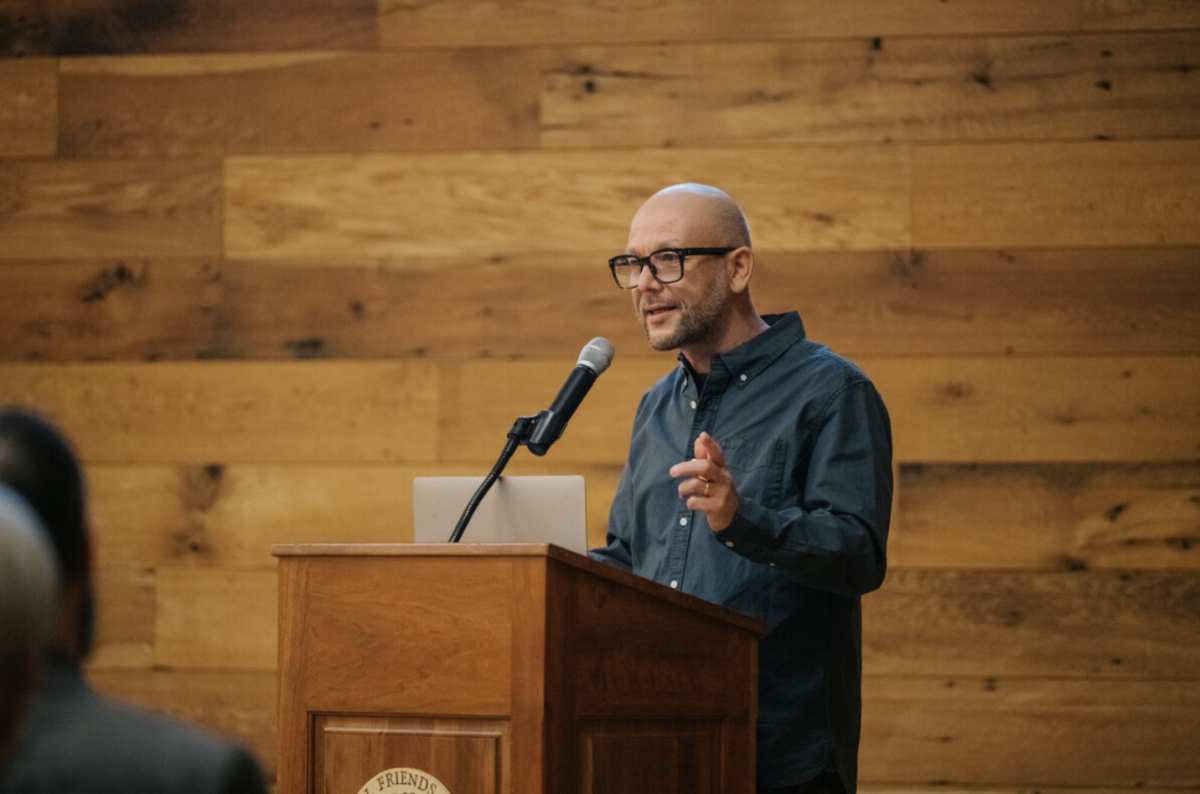
On Nov. 5th, German-Japanese American artist Kota Ezawa spoke to Upper School Students as the Rubenstein Artist Lecturer, sharing his experiences, successes and artistic background. His work has been featured at the Smithsonian American Art Museum and MoMA in New York City. Ezawa’s presentation offered students a perspective on what it means to be an artist and live a creative life. At the start of his presentation, Ezawa acknowledged that being an artist is both a privilege and a challenge. “I am honoured to write my job on my tax returns as an artist…[but] it was difficult to start making a living,” he told Upper Schoolers.
He spent his early years studying at an art school in Germany before going to graduate school in San Francisco. Ezawa shared that his multicultural background deeply shaped his early experiences. In Germany, he often felt like he stood out, but in the United States, he said, “[he] felt accepted and comfortable.”
Throughout his early artistic experience, Ezawa experimented with various media. Specifically, his interest in animation emerged before digital tools became popular. He and his friends created an animated music video that incorporated flashing colors and sound. Later, he made an animation corresponding with a radio tape from O.J. Simpson’s infamous court case verdict.
Ezawa said his intention was never to confine himself to a single medium. Although he enjoyed music and digital animation, he also wanted “to do something rooted in reality.” That experience led him to work as a legal videographer, where he observed firsthand the “theatrics of the courtroom.”
Over time, Ezawa’s career expanded beyond video. He created multiple public art installations that now appear at San Francisco International Airport, the Miami Philharmonic’s Symphony Hall and the Vancouver Art Gallery. By using different materials, Ezawa hopes to “expand visual language.”
Throughout the presentation, Ezawa emphasized the idea that art is not confined to galleries. “Art goes out into the open and infiltrates everyday life,” he said.
In addition to lectures for Upper Schoolers and parents, the annual Rubenstein Artist has their artwork displayed in the Arts Center. To perfect the exhibit, Middle School Art Teacher and Director of Art Exhibits Aaron Brophy paid special attention to organizing Ezawa’s videos and documentaries in a purposeful way.
“I tried to replicate one of Kota’s previous exhibitions in New York City’s Madison Square Park, titled “City of Nature” by placing a TV in the Sidwell courtyard as a way of alluding to the original premise of the show being outside,” Brophy said. “Even though we are in a school, I am trying to present the work the way it is perceived in a gallery or in a museum setting.”
The artwork’s charge and connection to culture is why Brophy selected Ezawa as this fall’s guest artist.
“Sometimes [Ezawa’s] ideas are coming from within his mind, and sometimes the ideas evolve from a collective energy and spirit,” Brophy said. “I think this kind of sensitivity in his process and in his creative life is really powerful.”
Ezawa’s work also reflects ideas of Quakerism familiar to every Sidwell student. Brophy notes, “the idea of light and more light fits so well within…and goes together with the projects the students are doing themselves.”
While Ezawa was presenting to the students, Brophy chose to project an image of the Empire State Building to help students fully immerse themselves in Ezawa’s art. Not only does it connect to the location where multiple pieces of his hang, but it also has a symbolic meaning. The notable building stands throughout the day and night, much like Ezawa’s outdoor public displays. Brophy further explains how the video image of the Empire State Building created a more immersive lecture experience than viewing art in a gallery.
“Often in an art gallery, when you sit there, you look at something for five minutes and then leave. But what made [the reception and lecture] so interesting was the “Empire” video playing in the meeting room for people to experience… gradually over time.”