




















Actress and technologist Eline Van der Velden introduced Hollywood’s first fully generated AI character, Tilly Norwood, on Sept. 27. Van der Velden’s creation of the digital performer has been sparking significant debate since its introduction to the industry. Van der Velden’s AI studio Xicoia launched the project to explore digital talent in film and television at the Zurich Summit, an annual film industry conference.
Norwood, whose online persona began in mid-2025 with polished, influencer-style posts, has attracted the interest of many formal modeling agencies, making her one of the first completely AI-generated performers to receive professional contacts.
Xicoia is the AI division of the larger production company Particle6 Group. Particle6 produced the comedic sketch “AI Commissioner,” which included Norwood in her first role. The Screen Actors Guild-American Federation of Television and Radio Artists (SAG-AFTRA) said in a statement that it’s important to remember that Norwood “is not an actor, it’s a character generated by a computer program that was trained on the work of countless professional performers.”
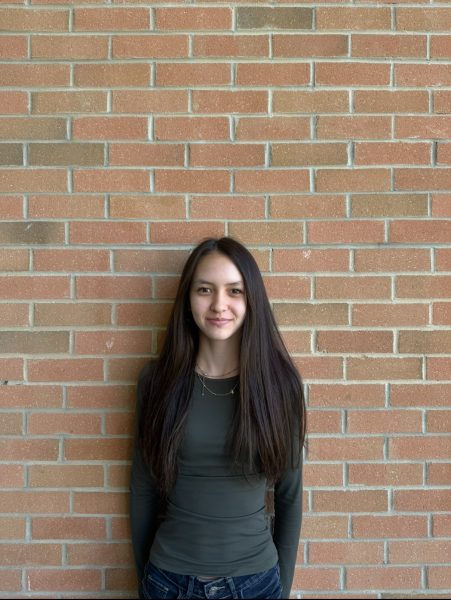
Sophomore Naomi Gedan agreed with this statement and said Norwood’s creation is “so creepy.” She further elaborated to say, “the arts are dying because robots can’t recreate human emotion, there’s no soul in it.”
Van der Velden has hinted that numerous Hollywood agencies are planning to sign the AI actress, and said “we’re working with a lot of them.” Following this statement, many other actresses pushed back against Norwood and agents who might proceed to sign Norwood.
These actresses are arguing that Norwood, who is trained to be able to replace the work of countless real performers, represents a rising threat to actors’ jobs and livelihoods, along with a negative impact on entertainment because it is removing a form of human connection.
Mexican actress Melissa Barrera posted Instagram stories pushing actors to drop any agent who signs Norwood. Barrera called Norwood’s creation “gross” and told agents and other actors to “read the room.” Emily Blunt expressed her concern over these developments.
“Good Lord, we’re screwed. That is really, really scary,” she said. Actress and filmmaker Natasha Lyonne added that Norwood’s creation was “deeply misguided and totally disturbed.” Lyonne similarly encouraged “any talent agency that engages in this [to] be boycotted by all guilds.”
SAG-AFTRA argued that Norwood’s creation can lead to “untether[ing] from the human experience,” and that the creation of Norwood is not a solution, but a means of erasing opportunity for real artists. “[Norwood] has no life experience to draw from, no emotion and, from what we’ve seen, audiences aren’t interested,” the union said. SAG-AFTRA also implied that Norwood’s creation may have poor effects on the entertainment industry if audiences can no longer connect emotionally to on-screen characters.
In response, creator Van der Velden posted on Instagram to defend the AI character. She claimed that Norwood “is not a replacement for a human-being, but a creative world — a piece of art.” Van der Velden also pointed out “AI characters should be judged as part of their own genre,” instead of being “compared directly with human actors.”
Van der Velden said her goal is to integrate this new technology into the industry alongside real actors to increase productivity, quality and efficiency. AI technology has already been applied in the film industry for the past years, but not to this extent. For example, studios have used AI to de-age actors, dub the voices of deceased or sick actors, or create imaginary sets. However, the introduction of an AI actress like Norwood represents a new phase where digital performers could play full roles in productions.
Gedan was skeptical of the benefits that Norwood’s creation could bring to the theater community. According to Gedan, “the only ‘upside’ is that she would never age and would do anything the directors said.” She further elaborated that this idea is “just control and creepy.”
Van der Velden has expressed her goal to make Norwood the next Scarlet Johansson, while others are comparing her to Natalie Portman, taking the interaction of AI in the entertainment industry to the next step. If Norwood secures an agency deal, she would be the first AI actress to enter the mainstream representation system.
Since Norwood’s arrival, there has been conversation about the future of AI actors for their efficiency in roles, commercials and experimental projects. As the entertainment and television industry struggles, this shift demands immediate action on new union contracts, ethical guidelines and regulations for AI representation and compensation. The success or failure of Norwood will be an important test, determining if the introduction of AI performers will transform filmmaking.